
Does a Will Avoid Probate in Pennsylvania? What Actually Happens to Your Property When You Die
Does a Will Avoid Probate in Pennsylvania?
No. Having a Last Will and Testament does not allow your estate to avoid probate in Pennsylvania.
Instead, a Will provides instructions for what should happen to certain property after your death and names the person you want to handle your estate.
But not everything you own necessarily passes through your Will. Some assets go through probate, while others pass directly to another person based on how the asset is owned or whether it has a valid beneficiary designation.
Understanding that distinction is an important part of creating an estate plan that actually works the way you intend.
What Is Probate in Pennsylvania?
Probate is the legal process used to recognize a Will and give someone authority to administer a deceased person’s estate.
When someone dies with a valid Will, the Will usually names an Executor. The Executor is the person chosen to handle the estate after death. People commonly name a spouse, adult child, family member, or trusted friend.
After the person’s death, the original Will is generally submitted to the Register of Wills in the appropriate Pennsylvania county. If the Will is accepted for probate and the named Executor qualifies to serve, the Register of Wills can issue Letters Testamentary. Those documents give the Executor legal authority to act on behalf of the estate.
The Executor can then identify and secure estate assets, address outstanding debts and expenses, handle required tax matters, and ultimately distribute the remaining estate property to the appropriate beneficiaries.
In other words, the Will gives the instructions. Probate is the legal process used to carry them out.
What Does a Pennsylvania Will Actually Do?
A Last Will and Testament explains what you want to happen to property that passes through your estate after your death.
A well-drafted Will can also make the estate administration process much clearer for the people you leave behind.
It Names an Executor
A Will typically names an Executor and may also name a backup Executor in case the first person cannot or does not want to serve.
That provides clear direction about who you want to be responsible for handling your estate.
It Names Your Beneficiaries
Your Will can identify the people or organizations you want to receive property from your estate.
For example, you may leave property to a spouse, children, other relatives, friends, or charitable organizations.
You can leave your estate generally among your beneficiaries or make specific gifts of particular property.
It Can Create a Testamentary Trust
A Will can also create a testamentary trust.
Unlike a living trust, a testamentary trust does not become effective until after your death. It can be particularly useful when property is being left to a minor, young adult, or someone who may need assistance managing an inheritance.
For example, instead of leaving money directly to a minor child, your Will could direct that the inheritance be held in trust. You can name someone to manage that property and establish rules for when and how it should be used or distributed.
It Can Nominate a Guardian for Minor Children
Parents can use a Will to state whom they would want to care for their minor children if a guardian becomes necessary.
A Will does not allow a parent to automatically appoint a guardian without court involvement, but the parent’s nomination can provide important guidance about their wishes.
It Can Make Specific Gifts
Your Will can also leave particular property to particular people or organizations.
For example, someone with a vintage car collection might leave the collection to a specific family member, museum, or automobile organization.
It Handles Whatever Is Left
A good Will should also include a residuary clause.
The residuary estate is essentially whatever remains after specific gifts, expenses, debts, taxes, and other required distributions have been handled.
The residuary clause says who receives that remaining property.
This is important because most people buy, sell, and replace property throughout their lives. A residuary clause helps prevent every change in your property from requiring an update to your Will.
What Assets Go Through Probate in Pennsylvania?
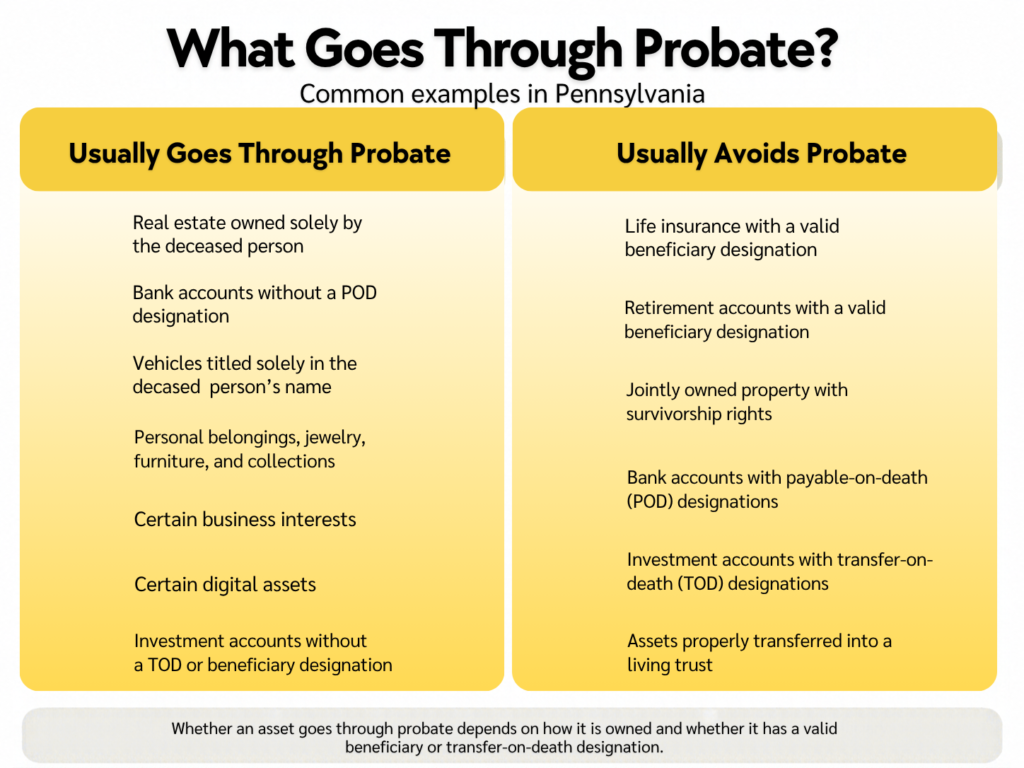
Generally, probate applies to property that a person owned individually at death and that does not have another method for transferring automatically to someone else.
Common examples may include:
- Real estate owned solely by the deceased person
- Individually owned bank accounts without a payable-on-death designation
- Vehicles titled solely in the deceased person’s name
- Clothing, jewelry, furniture, and other personal belongings
- Collections, tools, and equipment
- Certain business interests
- Certain digital assets
- Individually owned investment accounts without a transfer-on-death or beneficiary designation
This is not an exhaustive list.
Whether a particular asset becomes part of the probate estate depends on how it is titled, whether someone else has survivorship rights, and whether there is a valid beneficiary or transfer-on-death designation.
What Assets Usually Do Not Go Through Probate?
Many assets transfer outside of probate because another document or ownership arrangement already determines who receives them.
Common examples include:
- Life insurance with a valid beneficiary designation
- Retirement accounts with a valid beneficiary designation
- Certain jointly owned property with survivorship rights
- Bank accounts with payable-on-death designations
- Investment accounts with transfer-on-death designations
- Assets that were properly transferred into a living trust during the owner’s lifetime
This distinction is particularly important when it comes to life insurance.
A Will generally does not override a valid life insurance beneficiary designation.
If your life insurance policy names your daughter as the beneficiary, writing in your Will that you want the proceeds to go to your son generally does not change the beneficiary of that policy. Life insurance beneficiary designations are governed separately from transfers made through a Will.
The same basic principle applies to many retirement and employee-benefit accounts.
If no beneficiary is properly designated, however, that does not necessarily mean the benefit automatically becomes part of the estate or passes under Pennsylvania’s intestacy laws. The policy, account, or benefit plan may contain its own rules identifying who receives the benefit when no beneficiary is on file.
That is one reason beneficiary designations should be reviewed as part of the estate-planning process—not treated as something completely separate from it.
Because Life Legal was originally built around life insurance litigation, we have seen firsthand how beneficiary designations can create serious disputes after someone dies.
A person may genuinely believe that writing in a Will, “I leave my life insurance to my daughter,” is enough. But life insurance policies have their own procedures for changing beneficiaries. A Will generally cannot be used as a substitute for following those procedures.
Your Will and your beneficiary designations need to work together.
Does My House Have to Go Through Probate in Pennsylvania?
Sometimes.
If you own your home solely in your name when you die, the property will generally become part of your probate estate.
But if you own the property with someone else, the answer depends on exactly how ownership is listed on the deed.
Certain forms of joint ownership include survivorship rights, which may allow the surviving owner to receive the property automatically after the other owner’s death.
That means you should know exactly how your property is titled before deciding what your Will should say about it.
What About Adding an Adult Child to the Deed?
Some parents consider adding an adult child to the deed of their home as a way to make things easier after they die.
That can create significant problems.
Once another person becomes an owner of the property, you may no longer have complete control over it.
For example, if you later decide to sell or refinance the home, the other owner may need to cooperate.
Adding someone to a deed can also expose the property to legal or financial issues involving that person. If the adult child is sued, has creditor problems, goes through a divorce, or experiences other financial difficulties, their ownership interest may create complications.
There can also be significant tax, inheritance, and public-benefits consequences.
For those reasons, adding someone to your deed solely to avoid probate should not be treated as a simple estate-planning shortcut. There are usually better ways to accomplish the underlying goal, depending on your circumstances.
Do I Need a Trust to Avoid Probate in Pennsylvania?
Not necessarily.
A trust is a legal arrangement that allows property to be held and managed according to specific instructions.
Two trusts commonly discussed in estate planning are living trusts and testamentary trusts.
Living Trust
A living trust is created during your lifetime.
With a revocable living trust, you can generally transfer property into the trust while continuing to manage it during your lifetime. You also name someone who can take over management of the trust after your death or incapacity.
One of the most important points about a living trust is that simply signing the trust document is not enough.
Property that is intended to pass through the trust generally needs to be properly transferred or titled to the trust.
When properly structured and funded, a living trust can allow certain assets to pass without going through probate.
Testamentary Trust
A testamentary trust is different because it is created through your Will and does not come into existence until after your death.
For example, a parent might want a house or inheritance held for a child who is still very young.
The Will could create a trust, name a Trustee to manage the property, and state when or under what circumstances the child should eventually receive it.
Because the testamentary trust is created through the Will, the Will still goes through probate before the trust is established and funded.
That is the major difference for probate purposes: a properly funded living trust may allow assets to avoid probate, while a testamentary trust is created through the probate process.
What Happens If I Die Without a Will in Pennsylvania?
If you die without a valid Will, you are considered to have died intestate.
That does not mean everything you own automatically becomes part of your probate estate.
Assets with valid beneficiary designations, survivorship rights, payable-on-death instructions, or other valid non-probate transfer arrangements may still pass according to those arrangements.
For property that does become part of your intestate estate, Pennsylvania law determines who inherits it.
An eligible person may need to be appointed as the Administrator of the estate. An Administrator performs many of the same functions as an Executor, but instead of being selected in a Will, that person receives authority through the estate-administration process.
The Administrator collects the estate assets, handles debts and expenses, and distributes the remaining property according to Pennsylvania’s intestacy laws.
One common misconception is that everything simply goes to your spouse.
It can be more complicated than that.
A surviving spouse’s share can depend on whether the deceased person also left surviving children or parents and, in some circumstances, whether the children were also children of the surviving spouse.
If there is no surviving spouse, Pennsylvania law provides an order for determining which relatives inherit.
The important part is this: if you do not make a Will, Pennsylvania law makes many of those decisions for you.
Is Avoiding Probate Always Necessary?
No.
Probate has developed a reputation for always being expensive, complicated, and miserable. Sometimes it is.
But probate itself is not automatically a disaster.
Problems are much more likely when there is no clear estate plan, family members disagree, beneficiary designations conflict with someone’s expectations, ownership of property is unclear, or the estate contains complicated assets and debts.
On the other hand, an estate with a valid Will, clearly identified beneficiaries, organized records, and straightforward assets may be much easier to administer.
The goal of estate planning should not simply be “avoid probate at all costs.”
The better goal is to create a plan that makes sense for your property, your family, and what you actually want to happen.
How Can I Make My Estate Easier for My Family to Administer?
The most effective estate plans are coordinated.
A Will is important, but it is only one piece.
A comprehensive estate plan may include:
- A Last Will and Testament
- Financial Power of Attorney
- Healthcare Power of Attorney or Advance Healthcare Directive
- Trust planning, when appropriate
- Review of real estate ownership
- Review of life insurance beneficiary designations
- Review of retirement-account beneficiary designations
- Review of payable-on-death and transfer-on-death accounts
The goal is to make sure all of those pieces work together.
You do not want your Will saying one thing, your life insurance beneficiary designation saying another, and the deed to your home creating an entirely different result.
Good estate planning is about more than preparing documents.
It is about creating a clear, coordinated plan so the people you leave behind are not forced to figure out what you meant after you are gone.
Frequently Asked Questions About Wills and Probate in Pennsylvania
Ready to Make Sure Your Estate Plan Actually Works Together?
A Will is an important part of an estate plan, but it is only one piece. Your beneficiary designations, property ownership, powers of attorney, healthcare documents, and any trust planning should all work together to reflect your wishes.
Life Legal Services offers estate planning services designed to make the process clear, practical, and personalized to your family.
Schedule a consultation to start building an estate plan that gives you—and the people you love—clear direction for the future.